01142908809
Request a call back

Request a call back
Request a call back
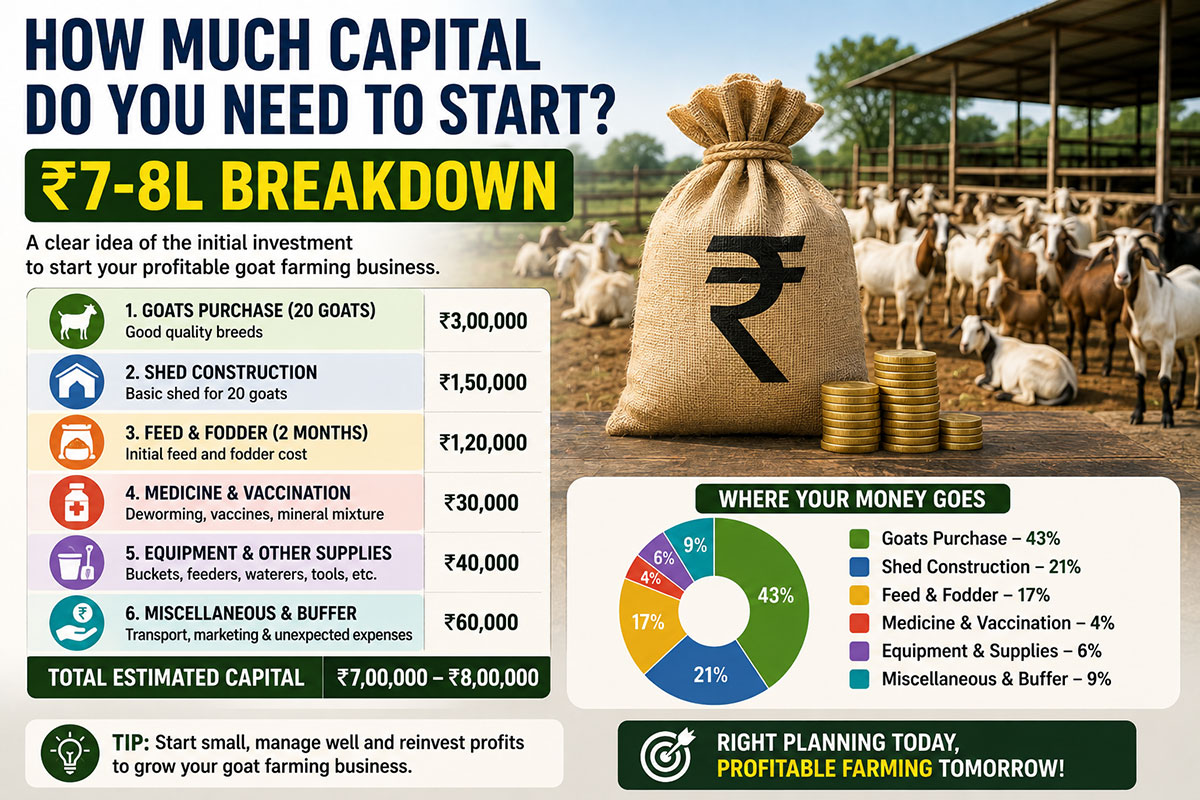
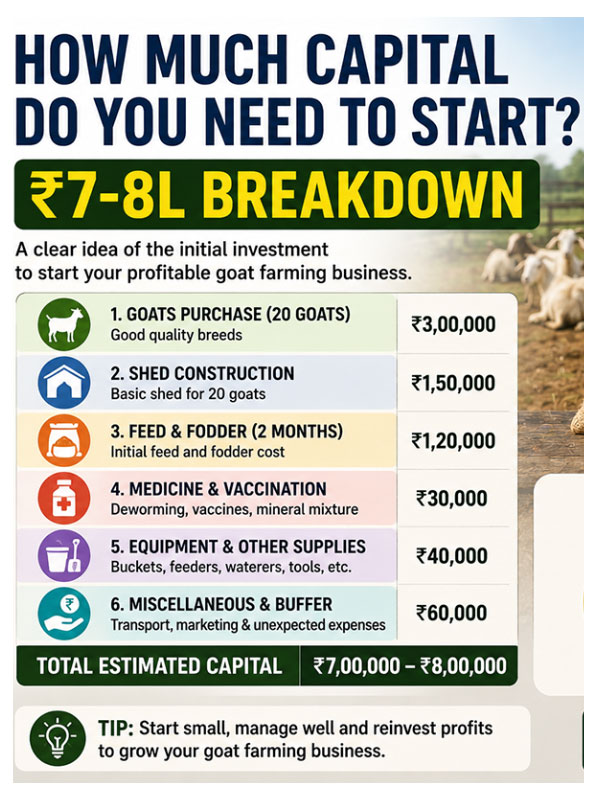
“How much money do I actually need?” is the first question every prospective goat farmer asks — and the honest answer is that it depends heavily on scale, land ownership, and region. That said, a commonly cited entry point for a small commercial unit (roughly 30–40 breeding goats) is in the ₹7–8 lakh range. Here’s what that figure typically includes, and where costs can swing.
A basic elevated-floor shed with proper ventilation, drainage, and predator-proofing is usually the single largest line item if you’re building from scratch. Costs vary widely based on materials (bamboo/local wood vs. concrete and steel) and whether you already own suitable land.
Buying 30–40 breeding does plus a small number of bucks makes up the next largest share. Breed choice significantly affects this number — Boer and Jamunapari typically cost more per head than Sirohi, Barbari, or Osmanabadi.
This includes initial feed stock, mineral mixtures, and — if you’re growing your own fodder — the cost of establishing Napier grass or similar. Farms that invest in fodder self-sufficiency early reduce their ongoing monthly costs meaningfully.
Borewell or piped water access, storage tanks, and delivery systems are easy to underestimate in initial planning, especially on land without existing water infrastructure.
A commonly overlooked but critical line item: 3–4 months of running costs held in reserve, so an early setback (disease, weak monsoon, slow first sales) doesn’t force a fire-sale of animals.