01142908809
Request a call back

Request a call back
Request a call back
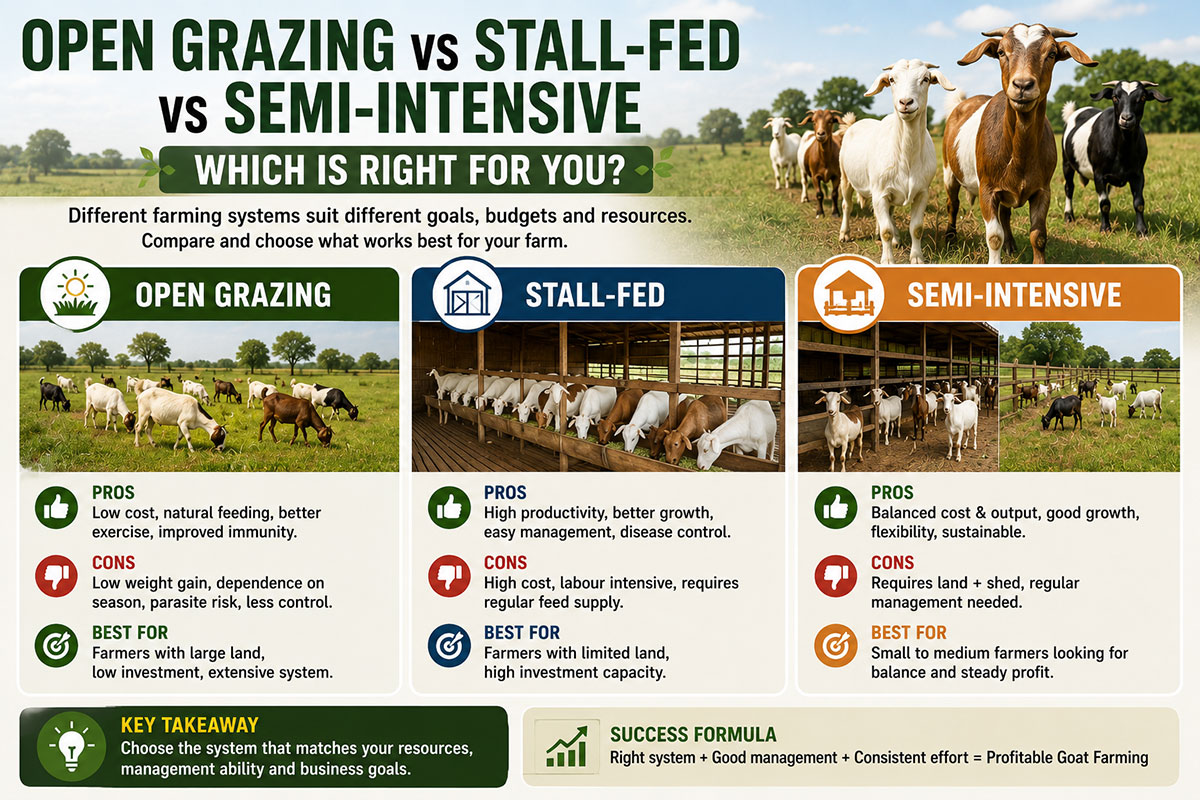
One of the earliest and most consequential decisions in goat farming is choosing a rearing system. The three common models — open grazing, stall-fed (zero grazing), and semi-intensive — each come with different land requirements, cost structures, and management demands. Getting this choice right early saves a lot of rework later.
In open grazing, goats roam and forage for most of their diet, with minimal supplementary feed. This is the lowest-cost model to run day-to-day, since feed cost drops sharply. It suits farmers with access to common grazing land or large private plots, and hardy breeds like Sirohi and Osmanabadi handle it well. The trade-offs: slower, less predictable growth rates, higher disease and parasite exposure, and land requirements that put this model out of reach for many smaller or peri-urban farmers.
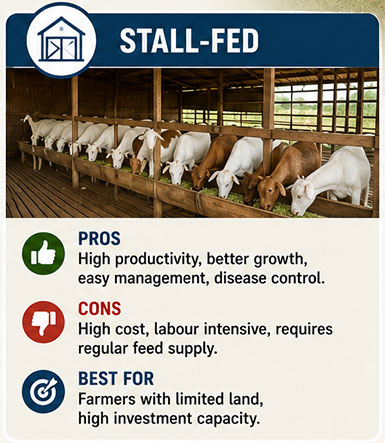
Here, goats stay in the shed and all feed is brought to them — cut fodder, concentrate, and mineral mixture. This model needs far less land, gives tighter control over nutrition and disease exposure, and generally produces faster, more predictable weight gain — a real advantage for meat-breed farms selling on a schedule. The cost is higher: more labour for cutting and carrying fodder, higher feed cost overall, and a real dependency on consistent fodder supply (which is why many stall-fed farms grow their own Napier grass).
This hybrid model — goats graze for part of the day and return to a shed with supplementary feed — is the most common choice among Indian commercial farms for good reason. It balances lower feed cost against better growth control than pure open grazing, while needing less land than a fully open system.