01142908809
Request a call back

Request a call back
Request a call back
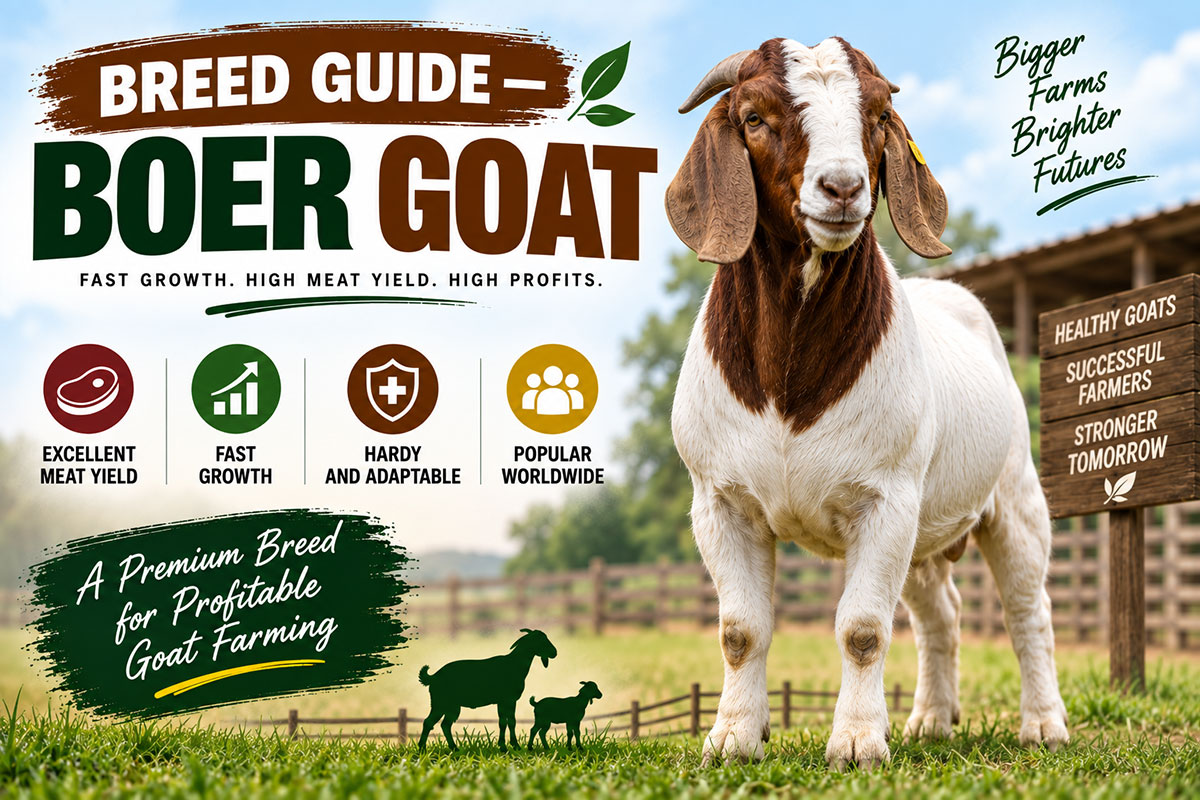
Boer goats, originally from South Africa and now widely raised across India, are best known for one thing above all: meat yield. For farmers focused purely on maximising output per animal, Boer is usually the first breed that comes up in conversation. Here’s a full look at what makes it stand out, and what it demands in return.
Boer goats are large-bodied with a distinctive white body and reddish-brown head, bred specifically over generations for muscle mass and fast growth — a visibly different build from most Indian native breeds.
Boer goats typically show faster weight gain and a higher dressing percentage (the proportion of live weight that converts to usable meat) than most Indian native breeds, which is why they’re heavily used both as a pure breed and, just as commonly, for crossbreeding with hardier local breeds to combine growth performance with regional disease resistance.
Many Indian farms use Boer bucks crossed with local does rather than raising pure Boer herds — this approach captures much of the growth advantage while retaining more of the local breed’s climate hardiness, often at a lower overall cost and risk than a pure Boer herd.
Boer (or Boer-cross) suits farmers with the feed budget and management capacity to support faster growth, and who are targeting buyers willing to pay for higher meat yield per animal. For farmers prioritising low-risk, low-input farming, a hardier local breed may be the better starting point, with Boer crossbreeding considered later as the operation matures.