01142908809
Request a call back

Request a call back
Request a call back
One of the fundamental early decisions in goat farming is whether to focus on milk or meat production — and the honest answer to “which pays better” depends heavily on your region, market access, and management style rather than a single universal answer. Here’s a practical comparison to help you decide.
Meat production benefits from a large, well-established market — mandis exist across virtually every region, and demand is broad-based rather than dependent on a narrow buyer type. Breeds like Boer, Sirohi, and Osmanabadi are widely available and well understood by local markets. The sales cycle is also more flexible — a farmer isn’t dependent on daily milk collection or a nearby dairy buyer.
Meat farming ties up capital in a growing animal for 8–12 months before sale, and per-animal margins — once fully costed — are often more modest than headline claims suggest. Price also swings meaningfully with season and events like Bakra Eid, adding some unpredictability to cash flow timing.
Milk production offers a more continuous income stream compared to the lump-sum nature of meat sale — daily or regular milk sale, rather than waiting months for a single payout per animal. Breeds like Jamunapari offer genuinely strong yields, and demand for goat milk (valued for specific dietary and health reasons by some consumers) can command a premium price in the right market.
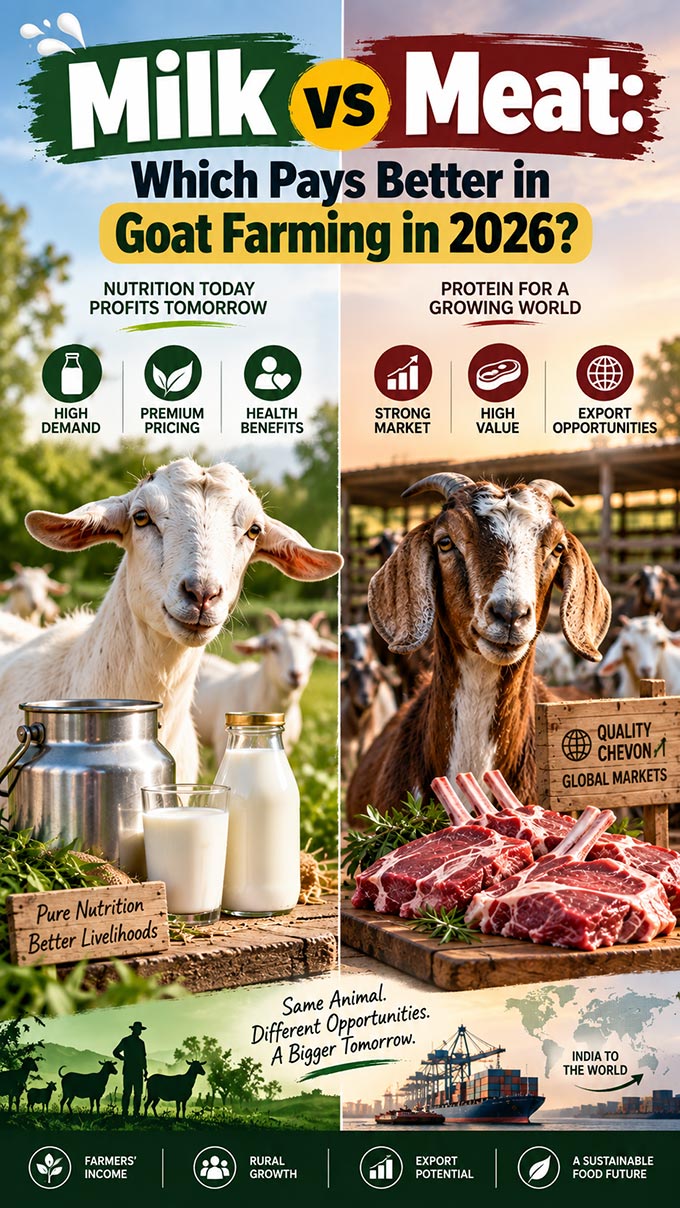
Milk farming depends heavily on having a reliable, nearby buyer — a dairy, direct consumer base, or processor — which isn’t available everywhere. It also requires more consistent, higher-quality feeding to sustain yield, and daily milking is a real, ongoing labour commitment that meat-focused operations don’t face in the same way.
For farmers with strong mandi access and a preference for a less daily-intensive routine, meat-focused farming is often the more straightforward path. For farmers with reliable access to a milk buyer and the capacity for consistent daily management, milk-focused farming can offer steadier cash flow and, in the right market, strong per-litre returns. Many farms also choose a dual-purpose approach specifically to hedge between the two rather than committing entirely to one.