01142908809

Request a call back

Write us
goatgyan@gmail.com

A92 C/2, Nambardar Estate,
New Friends Colony, New Delhi,110025

01142908809

Request a call back

Write us
info@goatgyan.com

Goat Manure as a Byproduct Income: The Organic Fertilizer Opportunity

Introduction

Goat manure is often treated as a farm waste product to be disposed of, when it’s actually a genuine secondary income opportunity — particularly as demand for organic fertilizer grows among Indian farmers moving away from purely chemical inputs. Here’s how to think about it as a real revenue stream rather than a byproduct to discard.

Why Goat Manure Is Valuable

Goat manure is generally well regarded as an organic fertilizer input — relatively nutrient-rich and, notably, less likely to “burn” plants compared to some fresher animal manures, making it usable with less intensive processing in some applications. Demand for organic fertilizer inputs has been rising alongside broader interest in organic and natural farming practices across India.

How Much Manure Does a Goat Farm Actually Produce?

Output scales directly with herd size — even a modest herd of 30–40 goats generates a meaningful volume over a year, particularly under a stall-fed system where manure is more easily collected than under open grazing.
Turning Manure Into a Sellable Product
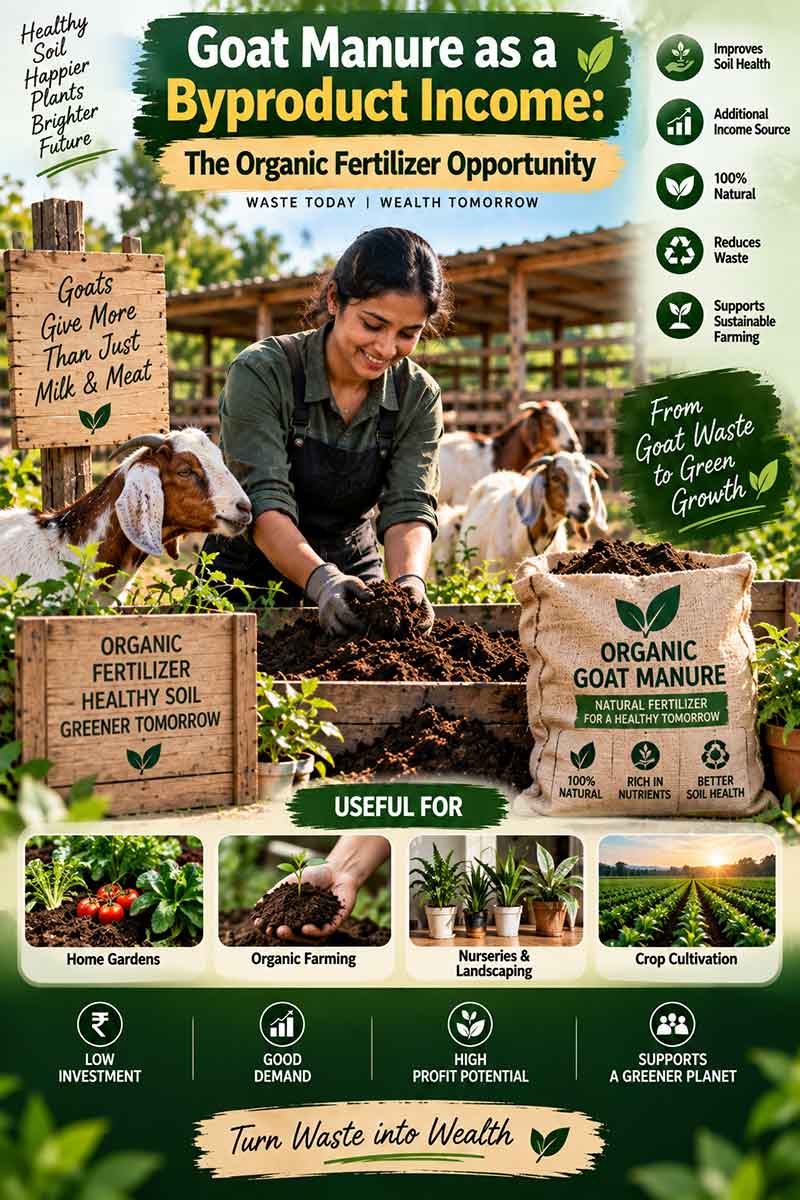
  • Basic collection and drying is the minimum viable step — even unprocessed, dried manure has sale value to nearby farmers.
  • Composting — combining manure with other organic material and allowing it to properly decompose — produces a higher-quality, higher-value product and is a relatively low-cost step up from basic collection.
  • Vermicomposting (using earthworms to accelerate and improve decomposition) is a further step some farms take to produce a premium organic fertilizer product, sold at meaningfully higher prices than raw manure.
Finding Buyers

Local crop farmers, especially those in your area moving toward organic or natural farming practices, are often the most accessible first buyers. Nurseries, kitchen gardeners, and, at larger scale, agricultural input dealers are additional channels worth exploring as volume grows.

Practical Considerations
  • Basic collection and drying infrastructure (a covered storage area) is a small investment relative to the income potential.
  • Composting or vermicomposting requires more space and process management but improves both product quality and price.
  • Even modest additional income from this stream contributes to overall farm profitability without any additional livestock cost — it’s revenue from something you already produce.
Key Takeaways
  • Goat manure has real commercial value as an organic fertilizer input, not just a waste product.
  • Even basic collection and drying makes it sellable; composting and vermicomposting increase value further.
  • Local crop farmers moving toward organic practices are often the most accessible buyer base.
  • This is genuine additional revenue from an existing farm output, at relatively low extra cost.

+911142908809 | 9911013303

goatgyan@gmail.com

A92 C/2, 4th Floor, Nambardar Estate, Taimoor Nagar, New Friends Colony, New Delhi, Delhi 110025