01142908809
Request a call back

Request a call back
Request a call back
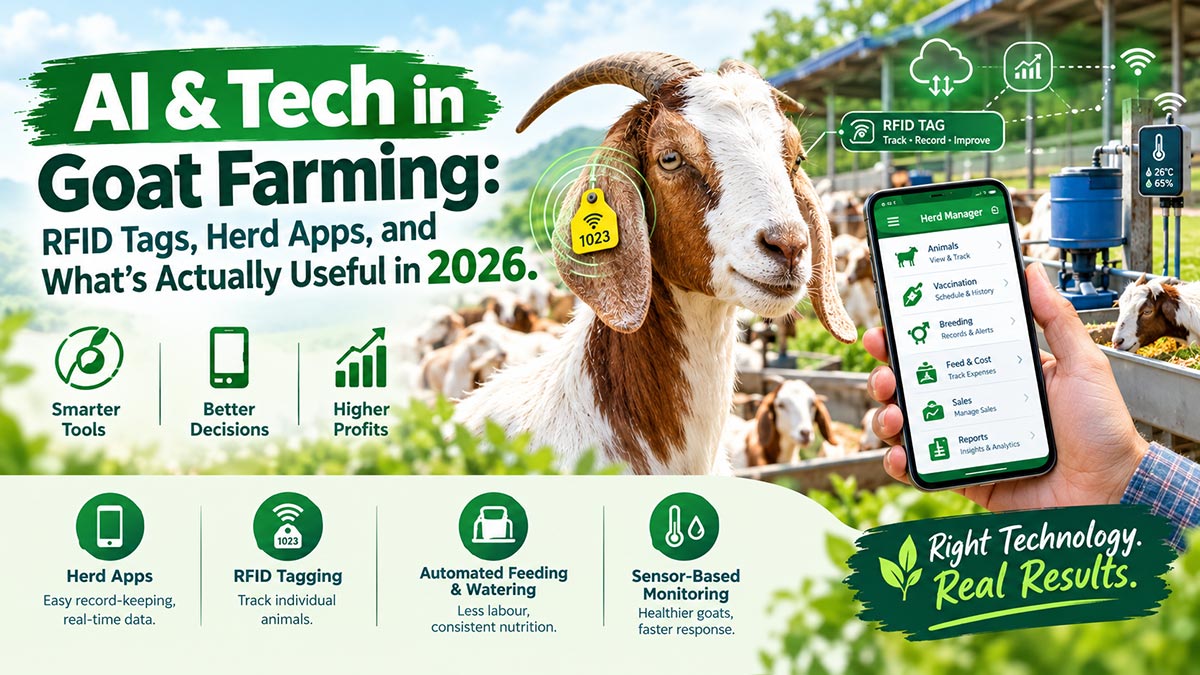
Technology adoption in Indian goat farming has historically lagged behind poultry and dairy, but that’s beginning to shift. From RFID tagging to smartphone-based herd management apps, a growing set of tools are becoming genuinely accessible — and useful — for small and mid-size farms in 2026.
RFID (Radio Frequency Identification) ear tags let farmers track individual animals — birth date, vaccination history, breeding record, growth measurements — without relying on memory or paper records that can be lost or become inconsistent over time. For farms above a certain scale, this individual-level tracking meaningfully improves decision-making, particularly around which animals to breed forward and which underperform.
A growing number of smartphone apps let farmers log vaccination schedules, feed costs, breeding records, and sales directly from the field, replacing scattered paper notebooks. Beyond convenience, this consistent data collection is exactly what’s needed to calculate real per-animal cost and profitability — the kind of analysis that most farms currently skip simply because the data isn’t organised.
Still more common on larger, more capital-intensive farms, automated feeders and waterers reduce labour dependency and improve feeding consistency. For smaller farms, the upfront cost is a real barrier, but worth monitoring as prices come down.
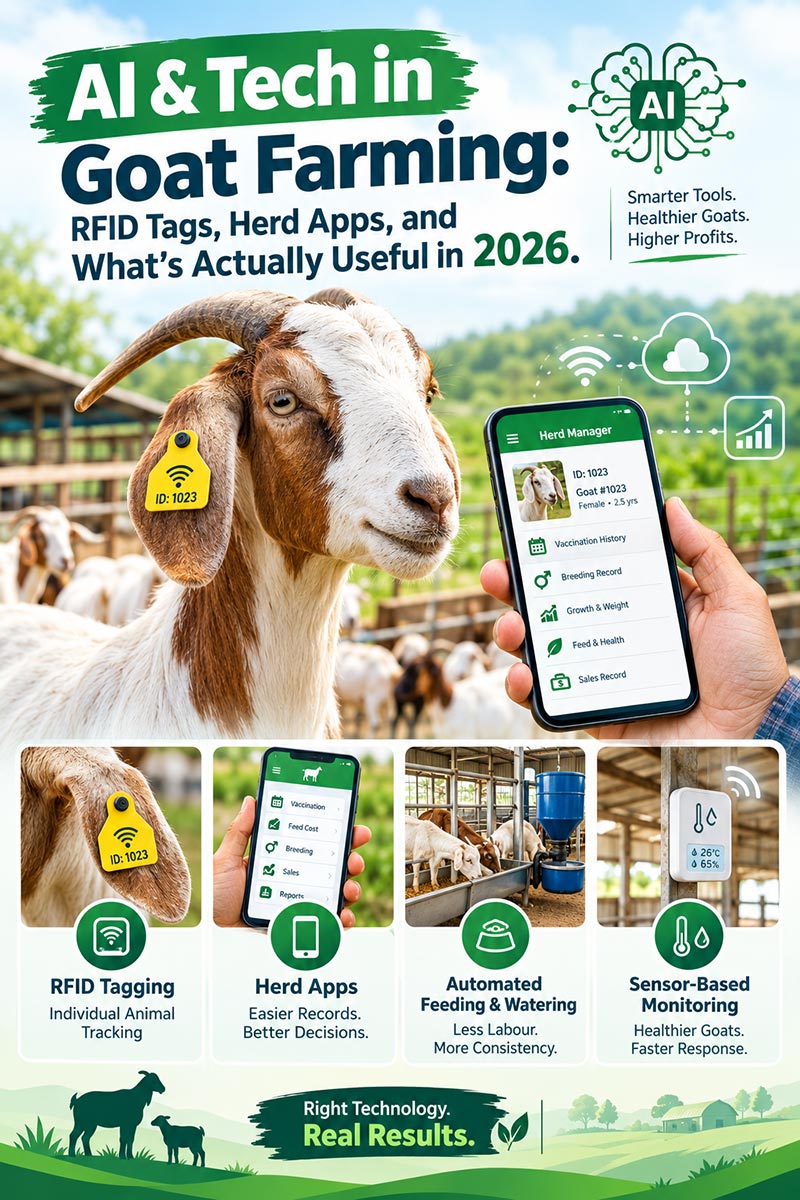
Emerging tools that monitor shed temperature and humidity can help farmers respond faster to conditions that raise disease risk — particularly useful heading into monsoon or extreme heat periods — though adoption among small Indian farms remains early-stage.
Not every tool suits every scale. For most small and mid-size farms in 2026, a simple herd management app is the highest-value, lowest-cost starting point — it directly improves the record-keeping that underlies almost every other good decision on the farm. RFID tagging becomes more clearly worthwhile as herd size grows past the point where individual-animal memory becomes unreliable. More capital-intensive automation is generally worth considering only once a farm has scaled significantly.