01142908809

Request a call back

Write us
goatgyan@gmail.com

A92 C/2, Nambardar Estate,
New Friends Colony, New Delhi,110025

01142908809

Request a call back

Write us
info@goatgyan.com

Goat Farming Loan: MUDRA vs NABARD Route Compared

Introduction

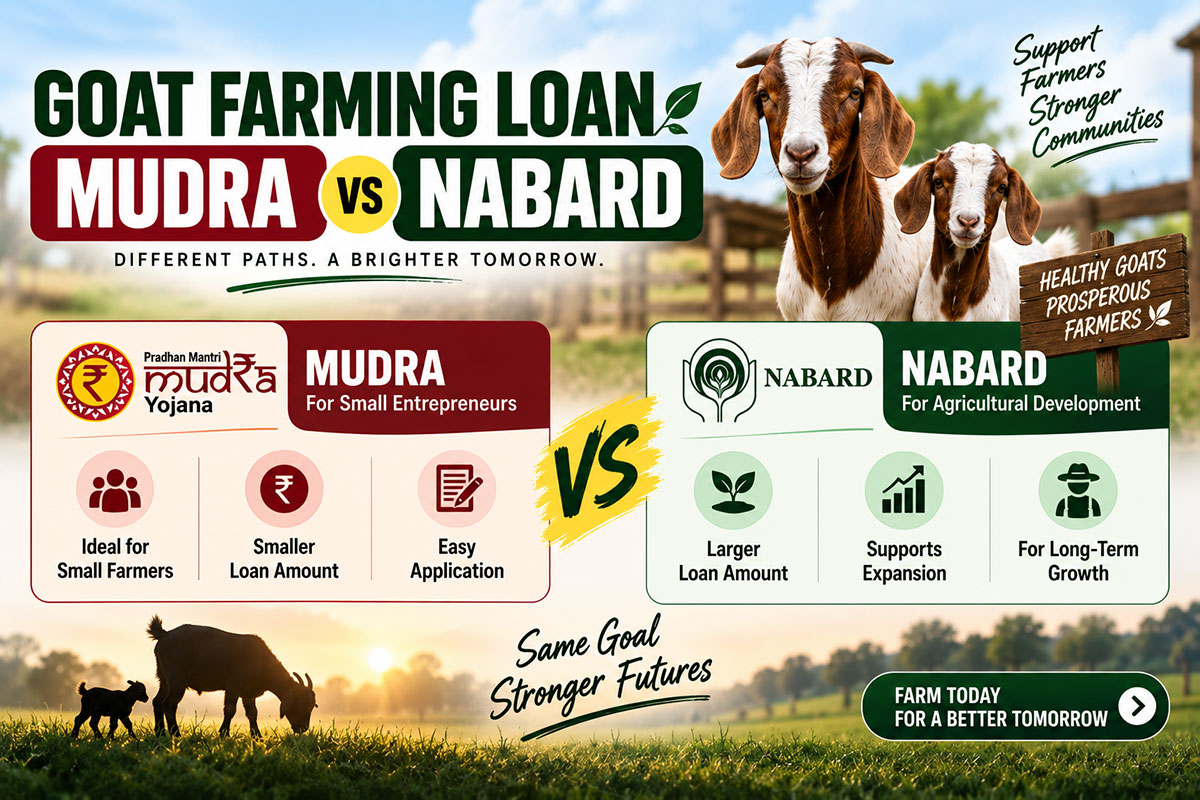
New goat farmers financing their setup in India usually end up comparing two main routes: a MUDRA loan, or a NABARD-linked subsidy loan through a participating bank. They work differently, suit different farm sizes, and it’s worth understanding both before you commit.

MUDRA Loan: The Basics

MUDRA (Micro Units Development and Refinance Agency) loans are aimed at small business financing generally, including agri-allied activities like goat farming, and are typically collateral-free up to defined limits across its Shishu, Kishor, and Tarun categories. For a small-scale goat farming setup, this can be a faster, simpler route than a full agricultural project loan, particularly for farmers without land to offer as security.

NABARD-Linked Route: The Basics

The NABARD route, accessed through a participating bank, is more explicitly structured around agricultural/livestock project financing, with subsidy support commonly around 25% (general) or 33.3% (SC/ST, women) built into the structure. It typically requires a more detailed project report and is better suited to larger or more formally structured farming projects.
Key Differences
  • Collateral: MUDRA loans are generally collateral-free up to their category limits; NABARD-route loans may require land or asset security depending on loan size.
  • Documentation: MUDRA applications tend to be simpler; NABARD-route applications require a fuller project report and viability appraisal.
  • Subsidy: NABARD-linked loans often carry explicit capital subsidy support; MUDRA is primarily a credit-access scheme without a built-in subsidy component.
  • Scale fit: MUDRA suits smaller, simpler setups; NABARD-route financing suits more substantial commercial projects.
Which Route Fits Your Farm?
  • Small-scale, first-time farmer, limited documentation → MUDRA is often the faster, simpler starting point.
  • Larger commercial unit, want subsidy support, willing to prepare a full project report → the NABARD route is usually worth the extra documentation effort.
  • Uncertain? Speak to your local bank branch about both options before committing — some farmers use MUDRA for an initial smaller setup, then move to a NABARD-linked loan when scaling up.
Practical Tips
  • Compare effective cost (interest rate net of any subsidy) rather than headline interest rate alone.
  • Ask your bank directly which scheme they process most smoothly — local bank familiarity with livestock lending varies significantly.
  • Whichever route you choose, a clear, honest project plan improves your outcome regardless of scheme.
Key Takeaways
  • MUDRA loans are simpler and typically collateral-free, suited to smaller setups.
  • The NABARD route offers explicit subsidy support but needs a fuller project report.
  • Compare effective cost, not just interest rate, when deciding.
  • Some farmers start with MUDRA and move to NABARD-linked financing as they scale.

+911142908809 | 9911013303

goatgyan@gmail.com

A92 C/2, 4th Floor, Nambardar Estate, Taimoor Nagar, New Friends Colony, New Delhi, Delhi 110025