01142908809

Request a call back

Write us
goatgyan@gmail.com

A92 C/2, Nambardar Estate,
New Friends Colony, New Delhi,110025

01142908809

Request a call back

Write us
info@goatgyan.com

Goat Vaccination Schedule: A Practical Guide for Kids and Adults

Introduction

Vaccination is one of the highest-leverage, lowest-cost investments any goat farm can make — a fraction of the cost of treating an outbreak, let alone the losses from mortality. Here’s a practical overview of what a sound vaccination schedule typically covers.

Why Vaccination Schedule Timing Matters

Vaccinating too early, while maternal antibodies from colostrum are still protecting a kid, can reduce vaccine effectiveness; vaccinating too late leaves a window of vulnerability. This is why following an established schedule — rather than vaccinating on convenience alone — genuinely matters.

Core Vaccinations for Kids

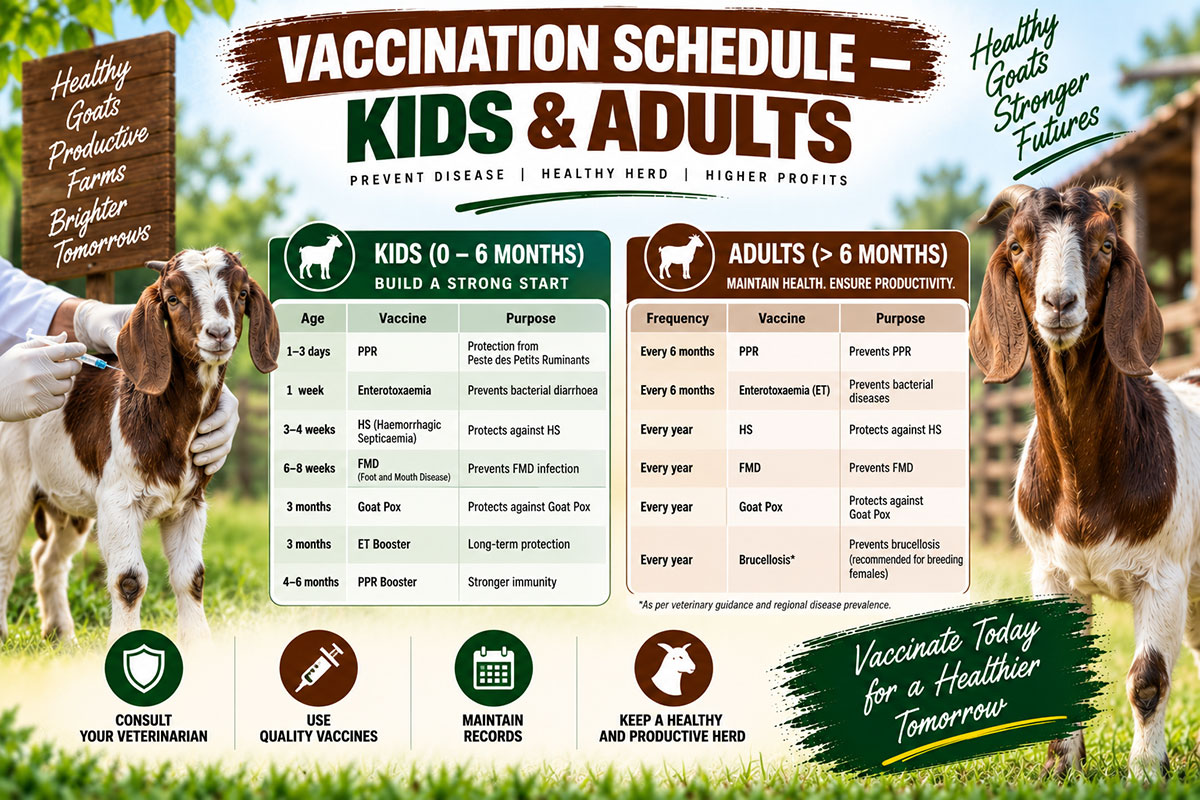
Young kids typically need protection against PPR (Peste des Petits Ruminants) and Enterotoxaemia among the priority vaccinations, generally beginning at a few months of age once maternal antibody protection has declined, with your local veterinary officer best placed to confirm exact timing for your region and any local disease pressure.

Core Vaccinations for Adults

Adult goats typically need periodic booster vaccinations against PPR, Enterotoxaemia, and, depending on regional disease prevalence, additional vaccines such as Foot-and-Mouth Disease (FMD) or Haemorrhagic Septicaemia (HS) as advised locally.
Building a Farm Vaccination Calendar
  • Maintain a written record for every animal — vaccine given, date, and next due date.
  • Align booster timing with your region’s seasonal disease risk (e.g., ahead of monsoon for certain diseases).
  • Vaccinate the whole herd on a coordinated schedule rather than piecemeal, to reduce the chance of an unvaccinated animal becoming a weak link.
  • Keep vaccines properly stored (cold chain) — improperly stored vaccines lose effectiveness even if administered on schedule.
Working With a Veterinary Officer

Exact vaccine types, dosing, and timing should be confirmed with your local veterinary officer or animal husbandry department, since disease prevalence and recommended protocols vary by region and can be updated over time. Building this relationship before you need emergency care pays off well beyond vaccination alone.

Key Takeaways
  • Vaccination is a low-cost, high-leverage investment against disease losses.
  • Timing relative to maternal antibody decline in kids matters, not just “eventually vaccinating”.
  • Keep written per-animal vaccination records and align boosters with local seasonal disease risk.
  • Confirm exact protocols with a local veterinary officer, since regional disease pressure varies.
Basic vaccination can often be administered by trained farm staff, but initial guidance from a veterinary officer on schedule and technique is strongly recommended, especially for new farmers.
Consult your veterinary officer — in many cases a delayed booster can still be given, but the animal may have reduced protection in the interim, so don’t skip it entirely.

+911142908809 | 9911013303

goatgyan@gmail.com

A92 C/2, 4th Floor, Nambardar Estate, Taimoor Nagar, New Friends Colony, New Delhi, Delhi 110025